
Mid Essex Anglican Academy Trust
Shaping the future of our trust together
How we develop our strategy

Research based - Our approach to developing a strategy at Mid Essex Anglican Academy Trust is influenced by the work of Richard Rumelt, one of the world’s most influential thinkers on strategy development. We also keep up to date with current advice and guidance, this currently includes reference to Education Endowment Foundation (EEF) research, ‘The writing framework’[DfE July 2025], 'Strong foundations in the first years of school' [Ofsted Oct2024] and the aims of Regional Improvement in Standards and Excellence(RISE) [DfE May 2025].
Our approach - We approach our strategy as problem solving. Leaders across our Trust and schools look at the issues, problems and obstacles of where our schools currently are and what we want to achieve for the pupils and communities we serve. We also look at what is working well. Once leaders have diagnosed challenges we face as a group of schools, we focus the way forward by identifying the ones that are most critical and addressable.
Prioritise - As a result, we are then able to focus on these issues and not spread resources or ourselves too thinly. Our approach simply means that we try to put the biggest challenge we face at the heart of our Trust strategy, we then focus in on that and avoid distractions. We build from our strengths, sharing expertise and provide comprehensive support.
Communicate - Throughout the process, we communicate our plans, actions and outcomes, ensuring stakeholders collaborate effectively.

Our strategy on a page
Vision
To unlock every child's potential as a unique child of God
Our guiding principles
To provide a safe, secure and caring environment, where every individual is an accepted and respected member of the school community. The pupils will experience a wide ranging, thematic, creative curriculum, learn to the highest standard, reaching the best possible individual outcomes and have fun too.
Priorities
- Raise attainment, focusing on English and maths and reducing the gap between disadvantaged and non-disadvantaged pupils.
- Ambitious reception year high quality education takes place.
- All pupils, including those with additional and/or complex needs are welcomed, feel they belong, are included, make personalised progress and have their success celebrated.
- Pupils have high attendance, enabling them to learn with absence impeding learning - pupils are proud to attend our schools.
Coherent action
The coordinated steps and tasks to carry out the strategy operationally owned by Trust leaders, focused on our priorities, communicated effectively.
Enablers
Strong financial leadership, providing sustainability; positive communications and engagement; highly effective governance at all levels; sound facilities management and consistent civic and social responsibility.
Trust key priorities
Our three year plan
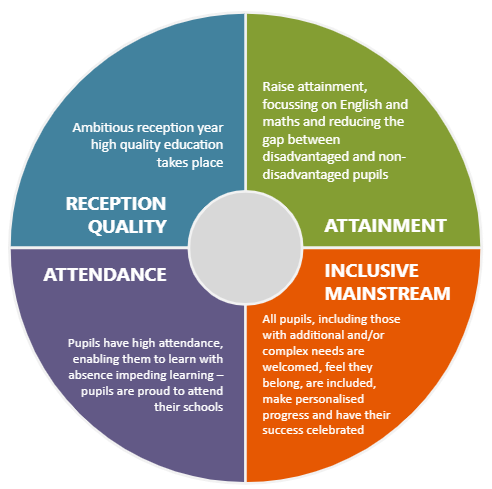
Our trust is following the Regional Improvement in Standards and Excellence key priorities for three years. We aim to provide the best possible education for all pupils, ensuring that all make progress and excel in some way.
Our trust improvement champions lead in the four areas, building on the best practice to successfully drive progress collaboratively.
ATTAINMENT - What we are trying to achieve:
To reach the best possible outcomes for all pupils in a safe, secure and caring environment, where every individual is an accepted and respected member of the school community. The pupils will experience a wide-ranging, thematic, creative curriculum, learn to the highest standard, reach the best possible individual outcomes and have fun too. To maintain above national average attainment and to raise attainment, focusing on English and maths, reducing the gap between disadvantaged and non-disadvantaged pupils.
INCLUSIVE MAINSTREAM - What we are trying to achieve:
To have highly effective inclusive practices ensuring that we unlock every child’s potential, through a full and through understanding of barriers to learning and appropriate adaptations to ensure all pupils progress well. All pupils, including those with additional and/or complex needs are welcomed, feel they belong, are included, make personalised progress and have their success celebrated.
RECEPTION QUALITY (and STRONG FOUNDATIONS) - What we are trying to achieve:
To provide highly effective quality EYFS provision including high-quality adult-child interactions, addressing the individual needs of all pupils, giving them the best possible start to school life and improving their life chances. Ambitious reception year high quality education takes place.
To ensure that we enable all pupils to secure strong foundations to access the curriculum, this involves effectively supporting pupils who are at the early stages of communication and language, reading, writing and mathematics, including older pupils whose development is not at their age-appropriate level.
ATTENDANCE (and BEHAVIOUR) - What we are trying to achieve:
Pupils have high attendance, enabling them to learn with absence impeding learning – pupils are proud to attend their schools. Their self-discipline and dedication to their learning, how they manage their own emotions and resolve conflict with others are supporting positive outcomes.
LEADERSHIP, MANAGEMENT AND GOVERNANCE -What we are trying to achieve:
The organisation of the trust is highly effective, ensuring that there is a coherent and strategic approach which in no way distract from the core purpose and aims.